Uptip Media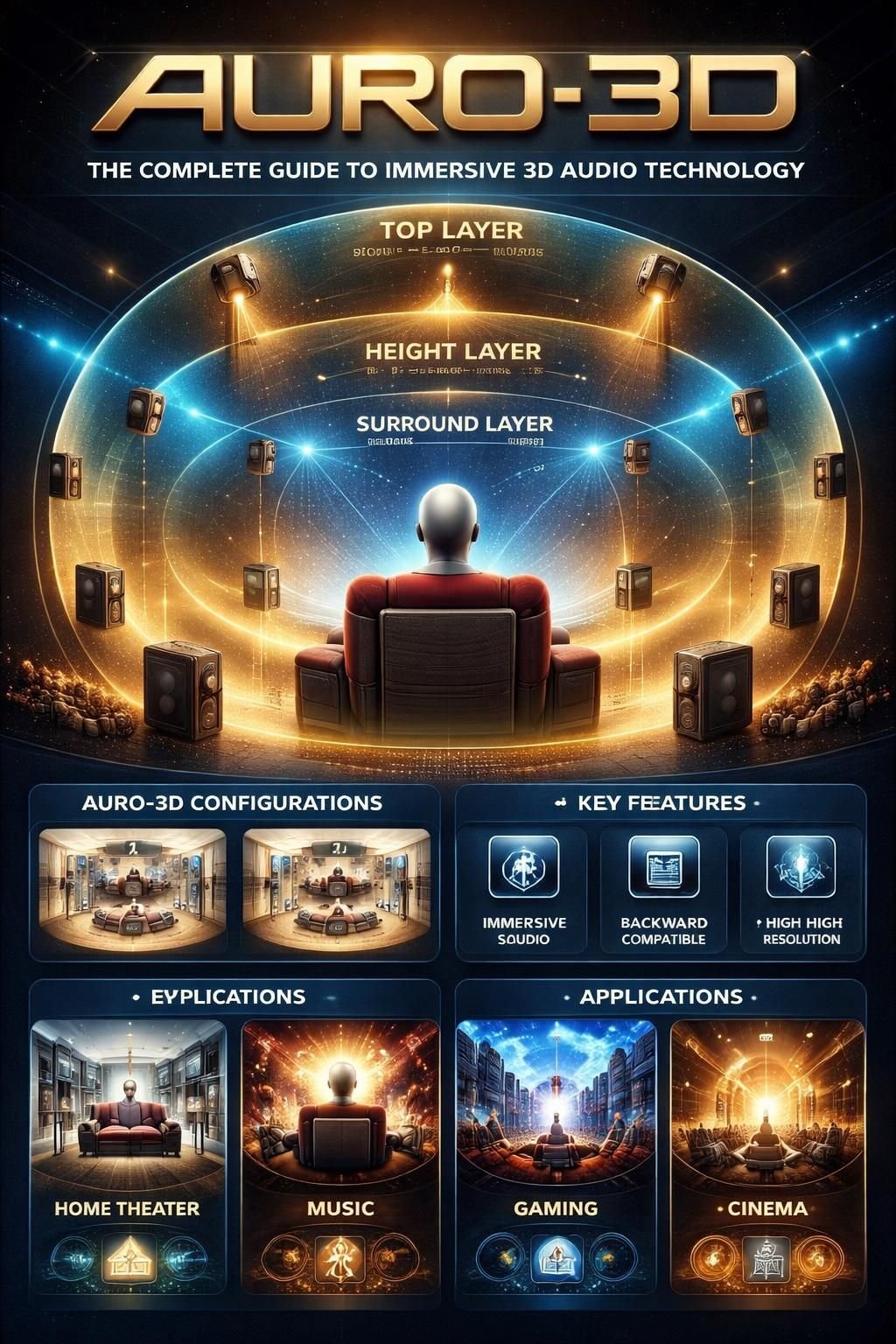
Auro-3D is a three-dimensional immersive audio format developed by Belgium-based Auro Technologies that wraps listeners in a full hemisphere of sound using three vertical layers — surround, height, and overhead ceiling. Unlike traditional 5.1 or 7.1 surround sound that moves audio horizontally around a listener, Auro-3D adds a vertical dimension that makes sound feel natural, spatial, and lifelike. Whether you are building a home theater, upgrading your cinema experience, or exploring audiophile-grade music streaming, Auro-3D offers a compelling, backward-compatible solution with uncompressed audio quality that rivals and often outperforms competing immersive audio formats on the market today.
What Is Auro-3D and How Does It Work
Auro-3D is an immersive sound format built on a fundamental insight: real-world audio does not travel only horizontally. Sound in nature rises, falls, and surrounds us from all directions, including from above. Auro Technologies, founded by Wilfried Van Baelen, developed the format in 2005 and officially introduced it at the AES Convention in Paris in 2006. The technology was later acquired by Goerdynamics BV in December 2024, continuing its growth into new markets.
The core architecture of Auro-3D rests on three audio layers. The first is the standard surround layer, which replicates conventional 5.1 or 7.1 horizontal sound. The second is the Height layer, which introduces speakers mounted above the existing surround array to reproduce reflections and elevated sounds. The third is the Top layer, a ceiling-level channel that creates the sensation of sound directly overhead. Together, these three layers form what Auro Technologies calls a “cocoon” of sound — an enveloping audio sphere that feels organic rather than artificial.
A key engineering achievement behind Auro-3D is its efficiency. Van Baelen recognized that most 24-bit digital audio recordings leave at least four bits unused. By encoding height and top layer information within those unused bits, Auro-3D can embed full spatial audio data inside a standard PCM carrier without increasing file size or requiring a separate audio stream. This makes it backward compatible with existing 5.1 and 7.1 playback systems, which simply ignore the height data and play standard stereo or surround as normal.
The History and Origins of Auro Technologies
The Auro-3D concept and initial speaker layouts, including Auro 9.1 and Auro 10.1, were presented to the industry at the AES Convention in 2006. In 2010, at the Spatial Audio Convention in Tokyo, Auro Technologies launched the cinematic formats Auro 11.1 and Auro 13.1, along with the Auro-Codec and Creative Tool Suite. Cinema rollout accelerated quickly after a partnership with Belgian display hardware company Barco in 2011, and the first major Hollywood film to be released in Auro 11.1 was Lucasfilm’s Red Tails. DreamWorks Animation subsequently committed to mixing 15 of its upcoming features in the Auro 11.1 format, beginning with Rise of the Guardians in 2012.
By 2015, Barco and Auro Technologies had debuted the AuroMax format, expanding channel options to 23 or 26 channels for large-scale cinema installations. The consumer side of the technology grew in parallel, with partnerships announced with Datasat Digital for high-end home audio processors. Today, over 150 cinema theaters worldwide are equipped with Auro-3D hardware, and the format is supported in AV receivers from Yamaha, Denon, Marantz, Onkyo, Pioneer, Trinnov, and StormAudio.
Auro-3D Audio Formats and Speaker Configurations
Auro-3D supports multiple speaker layouts to accommodate different room sizes, budgets, and use cases. Understanding the available configurations helps buyers and audio professionals choose the right setup for their needs.
Auro 9.1 uses a standard 5.1 surround base layer with four additional height-layer speakers positioned above the main horizontal array. This is the most accessible home theater configuration and the entry point for experiencing native Auro-3D content. Auro 10.1 adds a single Top channel speaker mounted in the ceiling for a more complete overhead experience. Auro 11.1 and Auro 13.1 are the primary cinema formats, featuring both height and ceiling layers across more speaker positions for large professional installations. AuroMax, the premium cinema variant, uses up to 26 channels divided into discrete zones along theater walls and ceilings, enabling object-level placement of sounds within the entire listening space.
One significant advantage Auro-3D holds over competing formats is that it does not always require ceiling-mounted speakers to achieve the height effect. Unlike Dolby Atmos, which specifies actual in-ceiling or Atmos-enabled upward-firing speakers, Auro-3D creates a “vertical coherent stereo field” using height-layer speakers mounted on walls above the surround level. This reduces installation complexity and cost, particularly for rooms where ceiling drilling is not practical.
Auro-3D vs Dolby Atmos vs DTS:X
The three major immersive audio formats — Auro-3D, Dolby Atmos, and DTS:X — each take a distinct approach to spatial sound. Understanding the differences helps consumers and professionals make informed decisions.
Auro-3D is the oldest of the three, first appearing commercially in cinemas around 2011. It is primarily a channel-based format, meaning audio is assigned to specific speaker channels rather than abstract three-dimensional objects in space. This approach has the advantage of being highly predictable, consistent across playback systems, and uncompressed, preserving full audio fidelity from production to playback. Auro-3D’s backward compatibility is also a major benefit, as native Auro-3D content can play on standard 5.1 or 7.1 systems without degradation.
Dolby Atmos arrived commercially about a year after Auro-3D and rapidly expanded in the home market. Atmos is primarily an object-based format, allowing sound designers to place audio at specific coordinates in three-dimensional space and letting the decoder distribute those objects to available speakers. This offers more flexibility in content creation but requires Atmos-enabled equipment and, for optimal results, actual ceiling speakers or upward-firing Atmos modules. Dolby Atmos has a significantly larger catalog of consumer releases across streaming platforms, Blu-ray discs, and gaming.
DTS:X, announced in 2015, is also an object-based format and is similar in philosophy to Dolby Atmos. It offers competitive audio quality and flexible speaker configuration without requiring a fixed speaker layout, making installation somewhat more forgiving. Like Atmos, DTS:X has strong industry support and a growing library of compatible titles.
For audiophiles and music enthusiasts specifically, Auro-3D has a compelling case. Its uncompressed format, support for high-resolution audio up to 192 kHz, and the natural “height-first” philosophy of the format make it especially well-suited to music reproduction, where preserving the acoustic character of a recording is paramount.
Auro-CX: The Next-Generation Streaming Codec
One of the most important recent developments in Auro’s technology ecosystem is the introduction of AURO-CX, a next-generation audio codec designed for streaming and broadcast applications. Unlike the original Auro-Codec, which was built around uncompressed PCM delivery on physical media, Auro-CX is a scalable bitstream that adapts to available bandwidth without sacrificing audio quality where conditions allow.
Auro-CX can deliver everything from efficient lower-bitrate mobile streams to lossless high-resolution content at up to 192 kHz, all from a single unified bitstream. This scalability solves a practical problem that has limited immersive audio in streaming — the need to manage multiple versions of a file for different devices and connection speeds. With Auro-CX, a music streaming service can maintain a single master, then dynamically deliver the appropriate quality tier based on the listener’s device and bandwidth.
Platforms built on Auro-CX include AuroMasters, founded by Wilfried Van Baelen, which delivers adaptive immersive streaming across multiple quality tiers including lossless 24/192. Pure Audio Streaming, another key platform, launched with Auro-3D music in high-resolution, offering immersive content up to 7.1.4 at 24-bit/96 kHz as well as stereo at up to 24-bit/192 kHz and a binaural headphone tier.
Auro-3D for Home Theater: Setup and Compatible Devices
Setting up an Auro-3D home theater system requires three components: a compatible AV receiver or audio processor with an Auro-Codec decoder, a Blu-ray player or a media source capable of outputting Auro-3D content, and a speaker array that includes height-layer channels above the standard surround configuration.
On the receiver side, Auro-3D decoding is supported in premium models from Yamaha, including the AVENTAGE RX-A6A and the AVENTAGE RX-A8A, as well as high-end processors from Trinnov and StormAudio. Denon, Marantz, Onkyo, Pioneer, and Integra also offer compatible receivers. Yamaha’s flagship soundbars have recently added Auro-3D support, broadening accessibility beyond the traditional dedicated home theater market.
For content delivery at home, Auro-3D is available on select Blu-ray discs encoded in the native Auro format. Various media players including VLC Player and KODI support FLAC-based Auro-3D files when properly configured to output 8 channels of 24-bit audio over HDMI. The Artist Connection app for iOS and Android provides access to Auro-3D content with binaural headphone rendering for mobile listeners, using Auro-Headphones processing to create a natural spatial presentation without requiring any special hardware beyond a standard pair of headphones.
Auro-3D in Cinema and Professional Production
In professional cinema, Auro-3D is installed and supplied through Barco, whose AP243D audio processor supports both native Auro-3D content and the Auro-Matic upmixer for converting legacy content into the Auro format. The format is fully compatible with DCI (Digital Cinema Initiatives) standards and supports Single Inventory Distribution, allowing multiple audio formats to coexist within a single PCM carrier, simplifying distribution logistics for studios.
On the production side, Auro Technologies offers a Creative Tool Suite — a set of software plugins that integrate into standard digital audio workstations to enable native Auro-3D content creation. The suite includes tools for spatial panning, height-layer rendering, and final encoding into the Auro-Codec format. The Auro-Matic upmixer can also convert existing stereo or surround recordings into Auro-3D format, making it practical to enhance catalog titles without requiring a full remix from scratch.
Notable films that have used Auro-3D include Red Tails, Rise of the Guardians, The Croods, Turbo, Black Panther, Spider-Man: Homecoming, and How to Train Your Dragon 2. The first Indian film to use Auro-3D was Vishwaroopam in 2013.
Auro-3D for Music: A Natural Immersive Audio Experience
Music has always been at the heart of Auro-3D’s design philosophy. Unlike cinema-focused formats that emphasize dramatic directional effects, Auro-3D approaches music from the perspective of natural acoustic space — reproducing the height, depth, and ambient richness of a real performance environment.
Immersive audio producer Morten Lindberg, who recorded the album MAGNIFICAT in Auro-3D in 2014, described the experience of creating in the format as being able to sculpt sound spatially, giving listeners the ability to relate to it from different positions within the aural space and delivering the most natural, emotional musical experience possible.
Auro-3D is well-suited to classical, jazz, orchestral, and acoustic music genres where the natural reverb and spatial character of a recording venue are part of the artistic experience. The format’s uncompressed delivery and support for sample rates up to 192 kHz mean that the finest sonic details are preserved from microphone to speaker. Hi-res music platforms adopting the Auro pipeline are particularly focused on audiophile-grade fidelity, with Grammy-winning studio content, meticulous remasters, and immersive reissues driving catalog growth.
Auro-3D on Mobile and Headphones
Auro-3D’s reach extends beyond the dedicated home theater into mobile and headphone listening through the Auro-Headphones binaural rendering system. Available through the Artist Connection app on iOS and Android, Auro Binaural processes immersive Auro-3D audio into a two-channel headphone signal that preserves the spatial height and depth of the original mix. Rather than simply placing sounds to the left and right, Auro Binaural is designed specifically for music listening, creating the sensation of being inside a performance space rather than having audio artificially positioned around the head.
For in-vehicle applications, Auro Technologies has developed partnerships to bring Auro-3D into automotive audio systems. The format is also being positioned for use in mobile phones and tablets, where the Auro-Scene processing provides a virtual immersive sound field even on a device’s built-in stereo speakers.
Key Benefits of Auro-3D Audio
Auro-3D delivers several distinct technical and experiential advantages that differentiate it from other immersive audio formats. Its uncompressed audio quality preserves every nuance of the original recording without lossy compression artifacts. Its backward compatibility means native Auro-3D content plays correctly on any standard surround system, protecting existing equipment investments. Its height-first architecture reproduces sound in the way humans naturally perceive acoustic environments, making the experience feel more realistic and less artificially imposed. The Auro-Matic upmixer extends the format’s value to older content, enabling any stereo or surround recording to be presented in an enhanced spatial format. Finally, the Auro-CX codec makes all of these qualities deliverable over streaming networks at any bandwidth level, positioning the technology for long-term relevance in a streaming-dominant market.
Frequently Asked Questions About Auro-3D
What is Auro-3D in simple terms?
Auro-3D is a surround sound format that adds height and overhead audio layers to traditional horizontal surround sound, creating a three-dimensional sphere of audio that makes movies and music feel more natural and immersive.
How is Auro-3D different from Dolby Atmos?
Auro-3D is primarily channel-based and uses a height-layer speaker approach that does not always require ceiling speakers. Dolby Atmos is object-based, requires Atmos-enabled hardware, and has a much larger consumer content library. Auro-3D is often preferred for music due to its uncompressed quality and natural acoustic reproduction.
What equipment do I need for Auro-3D at home?
You need an Auro-3D compatible AV receiver (such as Yamaha AVENTAGE, Denon, or Marantz models), a source device capable of outputting Auro content, and a speaker system that includes height-layer speakers positioned above your standard surround array.
Can I listen to Auro-3D on headphones?
Yes. The Artist Connection app for iOS and Android uses Auro Binaural rendering to deliver a spatial Auro-3D experience on standard headphones without any special hardware.
Is Auro-3D backward compatible with standard surround sound?
Yes. Auro-3D encodes height information within a standard PCM carrier, so native Auro-3D content plays correctly on existing 5.1 or 7.1 systems. The height data is simply ignored by non-Auro decoders.
Which movies have been released in Auro-3D?
Notable titles include Red Tails, Rise of the Guardians, The Croods, Turbo, Black Panther, Spider-Man: Homecoming, How to Train Your Dragon 2, and American Sniper. The first Indian film in Auro-3D was Vishwaroopam (2013).
What is Auro-CX?
Auro-CX is the next-generation Auro audio codec designed for streaming and broadcast. It delivers scalable immersive audio from compressed mobile streams up to lossless 192 kHz high-resolution content from a single adaptive bitstream.
Where can I stream Auro-3D music?
Auro-3D music is available through AuroMasters and Pure Audio Streaming, both of which offer high-resolution immersive content at multiple quality tiers including binaural headphone rendering.
Who invented Auro-3D?
Auro-3D was invented by Wilfried Van Baelen, CEO and founder of Galaxy Studios and Auro Technologies, who developed the concept in 2005 and officially introduced it at the AES Convention in Paris in 2006.
Is Auro-3D good for music or just movies?
Auro-3D was designed with music reproduction as a core priority alongside cinema. Its natural, height-first spatial philosophy and uncompressed audio quality make it particularly well-suited to classical, jazz, and acoustic music genres where acoustic space is part of the artistic experience.