Uptip Media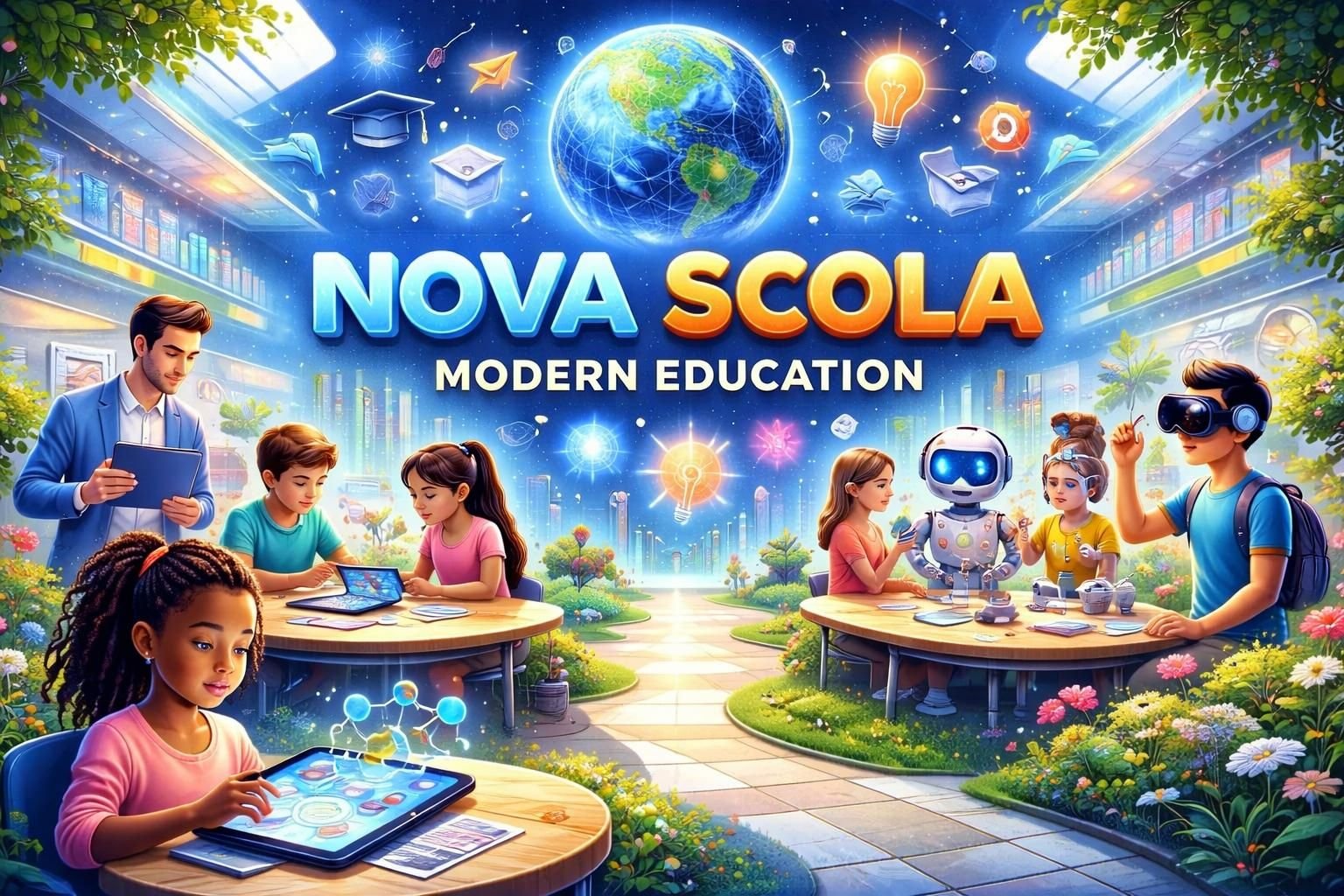
Introduction: What Is Nova Scola Modern Education?
Nova Scola modern education is a student-centered learning philosophy derived from the Latin words for “new school,” and it represents one of the most significant shifts in how the world thinks about teaching, learning, and preparing young people for modern life. Rather than relying on traditional lecture-based classrooms, standardized memorization, and one-size-fits-all assessment, Nova Scola reimagines education as a dynamic, personalized, and technology-enriched experience that adapts to the individual needs, pace, and strengths of every learner. Inspired by high-performing education systems in Finland, Singapore, and progressive learning communities across Europe and Latin America, Nova Scola blends critical thinking, project-based learning, digital literacy, collaboration, and real-world problem-solving into a cohesive educational framework built for the demands of the twenty-first century. Students under the Nova Scola model are not passive recipients of information — they are active participants in constructing knowledge, developing skills, and preparing for careers and lives that require adaptability, creativity, and emotional intelligence alongside academic competence. As traditional education systems face growing scrutiny for failing to keep pace with a rapidly changing world, Nova Scola offers a compelling, evidence-supported alternative that is already producing measurable improvements in engagement, attendance, and student outcomes in schools worldwide.
What Does Nova Scola Mean?
The term Nova Scola comes directly from Latin. “Nova” means new, and “Scola” means school. Together they form a declaration of intent — a new school, a new way of learning, a fresh approach to the purpose and practice of education.
In contemporary usage, Nova Scola does not refer exclusively to a single institution or software product. It operates on two levels simultaneously. On one level it describes an educational philosophy and framework that any school, teacher, or learning community can adopt. On another level, schools in countries including Brazil and Portugal have adopted the Nova Scola name as an institutional identity, building their programs around modern teaching methods, digital integration, and community-embedded learning.
Understanding Nova Scola correctly means recognizing it as a mindset and a methodology rather than a fixed curriculum or a branded product. Its principles can be implemented in a state-funded public school with modest resources, a private institution equipped with advanced technology, or a homeschool environment equally — because its foundation rests on how learning happens, not on what hardware or software is available.
The Core Principles of Nova Scola Modern Education
Nova Scola is built on four interconnected principles that together define a fundamentally different vision of what school is for and how learning should work.
Personalized Learning Pathways sit at the foundation of the Nova Scola model. The traditional approach assigns the same content, at the same pace, to every student of the same age regardless of their individual readiness, interests, or preferred learning style. Nova Scola rejects this model entirely. Using data-driven insights, adaptive digital tools, and observant teaching, Nova Scola matches the content, pace, and format of learning to each individual student, ensuring that no child is left behind through frustration and no child is disengaged through boredom.
Technology as a Learning Partner is the second core principle. Nova Scola does not treat technology as an add-on or a digital replacement for traditional teaching — it integrates technology meaningfully into the learning experience. AI-powered adaptive platforms, virtual reality simulations, gamified practice tools, and global collaboration software all serve as instruments that deepen engagement, provide instant feedback, and give students access to learning experiences that were impossible in conventional classrooms.
Project-Based Real-World Problem Solving is the third pillar. Nova Scola students learn by doing. Rather than studying topics in abstract isolation, they apply knowledge to real problems — designing a community garden, developing a budget, coding a simple application, analyzing a local environmental challenge. This approach builds deep understanding, practical competence, and the ability to transfer learning across contexts in ways that traditional memorization simply cannot achieve.
Life and Heart Skills form the fourth pillar. Nova Scola explicitly values emotional intelligence, communication, collaboration, resilience, digital citizenship, and ethical thinking as core educational outcomes alongside academic knowledge. These human skills are increasingly recognized by employers and researchers as critical determinants of long-term success in work and life — and Nova Scola treats their development as a deliberate educational priority rather than an afterthought.
How Nova Scola Differs from Traditional Education
The contrast between Nova Scola modern education and the conventional classroom model illuminates why the shift is both necessary and transformative.
Traditional education is teacher-centered. The teacher holds and delivers knowledge; students receive and reproduce it. Assessment is primarily through standardized tests that measure memorization and recall. The curriculum is uniform across all students of the same grade regardless of ability, interest, or background. Physical space is fixed — rows of desks facing a board. Mistakes are treated as failures rather than learning opportunities.
Nova Scola flips this structure entirely. The student is the center of the learning experience. The teacher becomes a facilitator, coach, and guide rather than the sole source of information. Assessment captures creativity, collaboration, problem-solving, and growth over time rather than isolated test performance. The curriculum adapts to the student. Learning spaces are flexible and designed to support different modes of working — individual inquiry, small group collaboration, and whole-class discussion all coexist. Mistakes are treated as essential data points in the learning journey, not as marks of inadequacy.
This is not a superficial stylistic difference. It represents a fundamentally different theory of what school is for. Traditional education was designed to produce workers for an industrial economy that valued uniformity and compliance. Nova Scola is designed to produce thinkers, creators, and problem-solvers for a knowledge economy that values agility, creativity, and continuous learning.
The Role of Technology in Nova Scola Education
Technology is one of the most visible and enabling features of the Nova Scola approach, though it is important to understand that technology is a tool in service of the philosophy — not the philosophy itself. The goal is always better learning, deeper engagement, and more meaningful skill development; technology simply expands what is possible in pursuit of those goals.
Artificial intelligence plays a growing role in personalized learning within the Nova Scola framework. AI-powered platforms can analyze a student’s performance in real time, identify gaps in understanding, recommend the next learning activity, and adjust the difficulty of tasks automatically. This gives every student something that was previously only available to children with private tutors — a learning experience that continuously adapts to their individual needs.
Virtual reality extends the learning environment far beyond physical classroom walls. History students can visit ancient civilizations. Science students can explore the human body from the inside. Geography students can stand in the Amazon rainforest. These immersive experiences create emotional memory and deep contextual understanding that reading a textbook page cannot replicate.
Gamified learning platforms convert practice and review into engaging interactive experiences that motivate students through reward systems, progress tracking, and playful competition. Global collaboration tools connect students across countries and time zones, giving them authentic experience of cross-cultural communication and teamwork before they enter workplaces where these skills are daily requirements.
Benefits of Nova Scola Modern Education for Students
Students who learn within a Nova Scola-aligned environment experience a range of significant benefits that extend well beyond improved academic test scores.
Engagement levels rise substantially when learning is active, personalized, and connected to real-world relevance. Early pilot data from 2024 and 2025 showed improvements of between 30 and 50 percent in measured student engagement in schools adopting Nova Scola principles, alongside meaningful reductions in absenteeism. When students feel that school matters — that what they are learning connects to their lives and futures — they show up and pay attention.
Critical thinking and creative problem-solving develop naturally through the project-based and inquiry-driven approaches at the heart of Nova Scola. Students practice these skills daily rather than being told about them abstractly. They learn to formulate questions, evaluate evidence, develop original solutions, and communicate their thinking clearly — all of which are capabilities that remain relevant and valuable regardless of how rapidly technology and industries change.
Collaboration skills grow through regular structured teamwork that Nova Scola classrooms intentionally build into the learning experience. Students learn how to listen, negotiate, contribute, and share credit — interpersonal competencies that employers consistently identify as among the most important and least developed in new graduates.
Confidence and intrinsic motivation strengthen when students have agency over their learning. Personalized pathways mean that students experience meaningful challenge and genuine success regularly, building a growth mindset that sustains learning far beyond the formal school years.
Benefits of Nova Scola for Teachers and Educators
Nova Scola transforms the professional experience of teaching as profoundly as it transforms the student experience of learning. Teachers who adopt Nova Scola methods consistently report greater professional satisfaction, stronger relationships with students, and a renewed sense of purpose in their work.
When teachers shift from delivering uniform content to facilitating personalized learning journeys, they see their students as individuals with distinct strengths, interests, and growth trajectories. This relational depth is one of the most rewarding aspects of teaching, and Nova Scola creates structural space for it that traditional lecture-based instruction often forecloses.
Technology tools available within the Nova Scola framework also empower teachers with real-time data about student progress, enabling them to intervene quickly and precisely when a student struggles and to challenge students who are ready to advance. This evidence-informed responsiveness replaces the guesswork that often characterizes teaching in conventional systems.
Professional development opportunities connected to Nova Scola implementation help educators build new skills, connect with global communities of innovative teachers, and experience a sense of continuous professional growth that sustains long-term career engagement.
Challenges of Implementing Nova Scola Modern Education
Nova Scola is a powerful and compelling educational vision, but implementing it in practice involves real and serious challenges that must be acknowledged and addressed honestly.
The digital divide remains the most significant structural barrier to Nova Scola adoption at scale. Not every school, district, or country has reliable internet access, sufficient device availability, or technical support capacity. Addressing this requires creative solutions — shared device rotations, downloadable offline learning modules, and phased implementation strategies that begin with low-cost digital tools before scaling toward more advanced technology as infrastructure allows.
Teacher training is the second major challenge. Research from early-adopter surveys indicates that approximately half of educators feel insufficiently prepared to implement technology-integrated, student-centered teaching effectively. Short, focused professional development sessions, peer coaching programs, and gradual implementation approaches — introducing one new method at a time rather than attempting a wholesale transformation — significantly reduce this barrier.
Assessment reform is a third challenge. Traditional examination systems measure a narrow range of academic recall skills. Evaluating the creativity, collaboration, communication, and critical thinking that Nova Scola prioritizes requires different assessment tools — portfolios, project presentations, peer evaluations, and competency-based rubrics — that many school systems have not yet developed or adopted.
Institutional resistance from administrators, parents, and policymakers accustomed to traditional education models also requires thoughtful change management, transparent communication, and patient demonstration of results over time.
Nova Scola and the Future of Education
Nova Scola aligns closely with the direction that leading international education organizations have identified as the future of learning. UNESCO’s Education Framework and the OECD Learning Compass 2030 both articulate visions of education that closely parallel the Nova Scola philosophy — emphasizing whole-person development, real-world competency, collaboration, and adaptability as the core outcomes that education systems must prioritize for the decades ahead.
As artificial intelligence continues to reshape every industry, the skills that Nova Scola develops — creativity, critical thinking, emotional intelligence, ethical reasoning, and the capacity for continuous learning — are precisely those that are least replicable by automation and most valuable in a world where routine cognitive tasks are increasingly performed by machines.
Schools around the world are already moving in the Nova Scola direction. Online education platforms, hybrid classroom models, competency-based progression systems, and experiential learning programs all reflect the same underlying shift that Nova Scola represents. The question for most educational institutions is no longer whether to change but how quickly and how deeply to commit to this transformation.
How Schools and Parents Can Begin Adopting Nova Scola Principles
Schools do not need to implement Nova Scola all at once. A gradual, iterative approach is more sustainable and ultimately more effective than attempting a complete overnight transformation.
Teachers can begin by introducing a single project-based learning activity into an existing unit. Over time, as confidence and competence grow, project-based approaches can become a larger and more central component of classroom practice. Incorporating one or two free digital tools — Khan Academy, Google Docs, collaborative presentation platforms — adds a technology dimension without requiring significant investment.
Parents can support Nova Scola principles at home by encouraging curiosity, embracing mistakes as learning opportunities, asking children questions about their learning rather than just their grades, and creating space for creative and independent projects outside of school hours.
School leaders can invest in teacher professional development as the highest-leverage action available. A well-supported, well-prepared teacher implementing Nova Scola principles with minimal technology will achieve better outcomes than an underprepared teacher equipped with the most advanced tools available.
Frequently Asked Questions About Nova Scola Modern Education
What does Nova Scola mean?
Nova Scola comes from Latin and means “new school.” It refers to a modern educational philosophy focused on student-centered learning, personalized pathways, critical thinking, real-world problem-solving, and technology integration rather than traditional lecture-based instruction.
Is Nova Scola a school or an educational system?
Nova Scola is primarily an educational philosophy and framework that any school or learning program can adopt. Some institutions in Brazil and Portugal use Nova Scola as an institutional name, but the broader concept functions as a model rather than a single school or organization.
How is Nova Scola different from traditional education?
Traditional education is teacher-centered, focused on memorization and standardized testing, and applies uniform content to all students. Nova Scola is student-centered, focused on creativity, collaboration, and real-world skills, and adapts the learning experience to each individual student’s needs and strengths.
Does Nova Scola require expensive technology?
Technology supports Nova Scola but is not its defining requirement. Many Nova Scola principles — personalized learning, project-based tasks, collaborative work, and student-centered facilitation — can be implemented with free digital tools or even without technology at all, depending on available resources.
Is Nova Scola suitable for all age groups?
Yes. Nova Scola principles apply across all stages of education from early childhood through adult and lifelong learning. The specific methods and tools used will vary by age and context, but the core philosophy of student-centered, real-world-focused, curiosity-driven learning is relevant at every level.
Can Nova Scola coexist with traditional education systems?
Absolutely. Many schools operate successful hybrid models that blend Nova Scola principles with elements of traditional structure. Project-based learning, personalized pacing, and collaborative assessment can all be introduced gradually within a conventional school framework without requiring complete institutional transformation.
What evidence exists that Nova Scola works?
Early pilot data from 2024 and 2025 from schools adopting Nova Scola principles showed between 30 and 50 percent increases in student engagement metrics and significant reductions in absenteeism. Research from high-performing education systems in Finland and Singapore, which share many Nova Scola principles, provides extensive longitudinal evidence of improved academic outcomes and student wellbeing.
How can parents support Nova Scola learning at home?
Parents can encourage curiosity by asking open questions, celebrating effort and learning from mistakes, supporting independent creative projects, limiting passive screen time in favor of active problem-solving activities, and maintaining open communication with teachers about how to reinforce Nova Scola approaches between school and home environments.